A year back we had discussed productivity vs joy as a framework for AI usage. This note looks at it from a create vs consume lens.
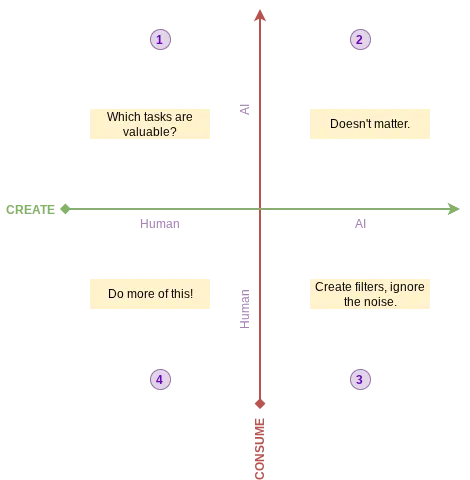
Let’s go in order.
Human → AI
The most prevalent use case is training LLMs based on human craft, code,
writing, art etc. Stealing content to create more copies at scale for human
consumption. It directly feeds the AI → Human 3rd quadrant.
If creativity is my bread and butter, I’d not expose them to AI. Our challenge: how do we put these constraints only for AI? Won’t we block feedback and inspiration by making world more closed than ever?
Other category is evaluations, e.g., AI validating form submissions, or grading assignments. This feedback loop aims at making humans better.
If AI can evaluate a piece of work, can it not produce it? If yes, over time
these tasks will move into AI → AI quadrant? E.g., would humans even create
hand crafted assignment submissions?
Next, the AI → AI doesn’t have much consequences for most of us. Let’s skip
ahead.
AI → Human
Social media feeds have been sequencing the order of consumption for almost a decade now. Only new element is they now control both the sequence and the garbage being fed. AI slop is here to stay.
Good news is in the longer term, humans are good at separating noise over signal. E.g., we do this for mass produced consumer goods. We get tricked once or twice, note the pattern, and steer away from the manufacturer for good. The challenge: discerning noise vs signal is a skill, and must be learned.
Building software or otherwise, I think low quality is a short term game. Once labelled noise or poor quality, it is hard to win back the consumer’s trust.
It will cost reputation to blindly throw slop. The ask for differentiation will emerge sooner than latter. An agency that only rides Stable Diffusion must find a way to survive. We’ve to see if speed over quality proves to be a fallacy.
Back to us, how do I deal with slop?
As with most industrial goods today, I will make a shift towards consuming quality. I’ve personally started spending more time with the small web. Head over to Indieblog, Kagi Smallweb, or Bubbles Town for a taste.
Books and movies are harder to choose, for now I am sticking to books from the non AI era.
I am transitioning to a meta search engine over the likes of Google for day to day use.
Human → Human
It may appear that all tasks in this quadrant can move adjacently to
AI → Human. We don’t have a clear answer to what really belongs here.
I’ve seen teachers ask existential questions on their value over an AI. Software
engineers are no different. It is possible that a task has lost its
significance. E.g., imagine few decades from now software need not be created by
humans any more. In this outcome, we will classify software dev as an
AI → {Human, AI} problem.
Knowledge, in contrast, is not mere information. If a teacher’s role is to share information, we had lost that battle several decades back with search engines, digital encyclopedias etc. If the role is to impart solid understanding and enable decision making, we still have work to do.
Any external source of knowledge, be it an all knowing oracle, cannot replace human judgment. If you know what to ask, use an AI. How do you know what to ask?
It is critical to find where I can lean on AI. For things I care about, where does AI impact my learning, accountability, and reputation?
On the creation side, I primarily contribute in form of code or words. This blog
never used AI content, and will continue to be hand crafted. I’ve been
AI sober designing/writing my own code for several weeks now.
There’s more to talk about this in the next post. See you around!